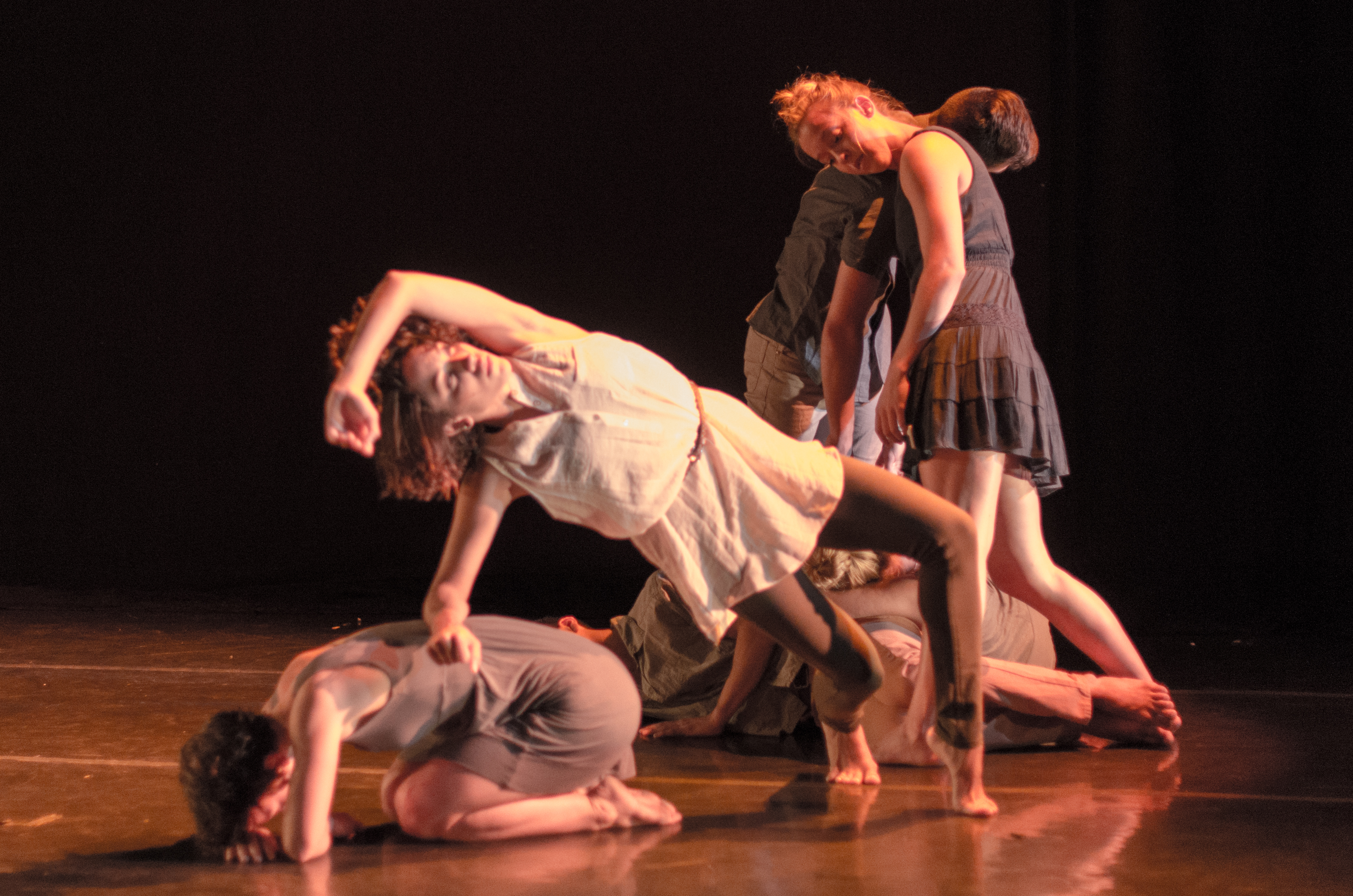
Chicago Dance Crash is so accustomed to doing something new that even when they do something for the first time, it's like they've done it a lot already. It's a unique talent for an entire Dance Company to have, but the performers and staff who make up Dance Crash all seem to have a set of abilities --- audacity, imagination, and multi-disciplinary performance skills --- that make it possible for them to keep doing new things well.
Beginning Saturday, May 25 (there's no Friday performance the opening weekend because Dance Crash is on tour) and running for three weeks, Dance Crash is presenting their new full evening work The Cotton Mouth Club, choreographed by Crash's multi-talented Artistic Director Jessica Deahr and Robert McKee, who also performs the male lead in the work. Jessica Deahr tells aotpr.com's Johnny Nevin about how all of that creativity comes together when Crash converts Chicago's famous Biograph Theater (now The Victory Gardens Biograph Theater because it's part of the award winning Theater Company) into The Cotton Mouth Club.
Johnny Nevin: The Cotton Mouth Club is another full evening dance play, like last year's Gotham City, which turned out to be such a success, except this is a very different way of looking at a story. How did you come up with the idea of telling the same story twice, but set in two different decades and with two different endings?
Jessica Deahr: I was set on the idea of using one artist, and finding an existing story within their music that I could weave together. Sort of like what Twyla Tharp did with Billy Joel's music in Movin' Out. I was deciding between a Michael Jackson show or an Outkast show when it dawned on me that both artists had songs that could potentially tell the same story in a different way. Neglected girl leaves guy, tension between two groups, decisions and regrets, the idea of time and memories, etc. It just clicked, what if I used both? Tell the story twice in two different eras, in two different ways? I stumbled upon the idea and then built on it from there with the idea of one decision changing the outcome the second time through.
The Phone Calls is a ten song invitation to hear one of the most difficult things you can try to do in music done really well; it's a mezmerizing tour through the art of writing and making a great instrumental song. The Phone Calls is the debut album by the band of the same name, a project put together by producer (and guitarist) Dan Agosto, and although Agosto mixes and produces in genres from metal to EDM to soundtrack, he's actually a guitar player before anything else. That has everything to do with why the ten songs on The Phone Calls can cover such a wide range of emotion and still play flawlessly together as an album. The whole idea is that the guitar is the voice of the song, and one of the reasons why a guitar, at least in the hands of somebody like Agosto, can be so effective as a melody lead is that it can say something just a little different each time you hear it.
"Guitar is my favorite instrument to play," Agosto says, "and it's easy for me to get simple ideas from inside my head onto a recording. From there anything is possible." The Phone Calls is a record of surf-guitar feelings and sounds, although from the first two tracks, both raging surf jams, the album travels through a thoughtful series of variations in mood and texture. "The idea for The Phone Calls is that the guitar is the lead instrument," Agosto explains, "Surf is definitely a style that lends itself to playing melodies on the guitar, especially on the lower strings. The distortion and echo effects that come to mind when I think of the sound of surf allow you to play things that can fill the space a vocalist would. It's a sound that was born from the instrument and just works."
The Auditorium Theatre of Roosevelt University's Music + Movement Festival has been one of the most creative programming concepts of the year. The idea was to showcase collaborations between dance companies and musical groups in a brilliantly diverse series of concerts that began February 28, and included eleven individual programs with as many different companies and musical ensembles. The project reaches its conclusion on Wednesday, May 15 on the Auditorium Theatre Landmark stage with the Music + Movement Showcase, in which six of the performances will be reprised along with a performance by Giordano Dance Chicago.
The line up is an impressive presentation of a spectacularly broad range of music and movement styles, offering an almost unprecedented opportunity to see the spectrum of ways that music and movement can inspire eachother. Even more impressive, and even more rare, is the presentation of live musical performances throughout the program.
Chicago Children's Choir has been defying the odds since they started, as a way to unite young people of different backgrounds, at the height of the Civil Rights movement. In 1956, the prospect of creating a successful organization that would teach and inspire children in a divided city to sing together, work together, and share with eachother everything that sharing music can bring seemed improbable at best. Chicago Children's Choir is still doing it, they're still defying the odds, and they're still inspiring and teaching and sharing.
On Wednesday, May 15 more than 3500 young people will celebrate Paint the Town Red: Inspiring Peace Through Song at the Pritzker Pavillion in Chicago's Millenium Park with a free concert, after which each of CC Choir's Neighborhood Choir Programs will continue the celebration with performances in public squares, community centers, and schools throughout the city. What they're defying now is the violence and danger that shatter so many young lives in so many communities. The idea of this concert is to give the young people who make up Chicago Children's Choir a chance to demonstrate their commitment "to making each of their communities a safer place to live and grow".
The free concert begins at 11 AM, and features guest performances by DJ Matt Roan, singer-songwriter Jay Adams, Chicago Children’s Choir Alumni The O’My’s, and Kevin Coval, Co-Founder of Louder than a Bomb: The Chicago Teen Poetry Festival.
Of all the intriguing Dance performances that anybody is going to put together this year, the one that Chicago Tap Theatre is presenting on Saturday April 20 just has to be one of the most promising. The much admired Chicago ensemble is joining with two of Europe's most imaginative tap companies in a program called Liaison; the whole idea is to show a one-night only audience at the Athenaeum Theatre just how many remarkable ways rhythm, movement, music and imagination, in other words tap dancing, can brighten a night.
Chicago Tap Theatre will share the Athenaeum stage with two very different groups of dancers, Tapage, from Toulouse, France, and Tap Olé from Barcelona, and perhaps the best short explanation of why this concert has so much to offer comes from Tap Olé's website, where the Company shares this insight: "... fusion is a universal language, which combines the creation of new and exciting sensations". Fusion is at the heart of Liaison, because the three Companies are not just presenting their own uniquely imaginative ideas of what tap dancings is, and is becoming, they also perform together, with live music, in a number of the works.
Pamela Fernandez is known as a singer, all around the world, even though almost none of the uncounted people who have danced, moved and who-knows-what-else to her tracks have any real idea who she is. A lot of people even know her name, especially the DJs, producers and labels who have played, remixed, resampled and rereleased her legendary vocals; they all know that Pamela Fernandez' voice can make a track and pack a dancefloor, but they probably know something else about her too. Most of the people who sampled and rereleased that legendary vocal probably know that Pamela Fernandez never got paid. She's been called "one of the most sampled voices in electronic music since 1992, although never credited in any of the releases", but almost none of the many thousands of clubgoers who have danced to her voice all over the world are likely to know that. What they do know is that she's a soulful, powerful, make-you-move singer.
Michelle Dorrance goes to a lot of places, and every time she does, she brings something. Just about anybody who sees her perform, checks out her choreography, or just reads about her in a magazine sees it right away, but If you asked every single one of them what it is that Michelle Dorrance brings, what exactly she has, you might never get the same answer twice. There are so many dimensions, so many perspectives, so many moving parts to everything she's doing that everybody sees it a little differently; she brings a lot to the art of sharing her art.
Surprisingly, it's possible to not even know about Michelle Dorrance if you don't know anything about the rich past, and richer present, of tap dancing; If you do, though, you really can't miss her. She's the one with the rocket-quick step, the stylish look and the bass-player-in-a-rock-band steadiness, the one on the cover of Dance Magazine, on Late Night with Jimmy Fallon with STOMP and Paul Simon, at The Blue Note Jazz Festival and at the United Kngdom's prestigious Royal Variety Performance. She's known both as a dancer and as a choreographer, as someone who can pull from the past while she pushes the future, and she's the only tap choreographer the Princess Grace Foundation has ever recognized with a Choreography Fellowship.
"One of the coolest things about art, in all forms, is how much it influences and inspires new art." That's just one of the many insightful ideas that come up when you talk to choreographer Mary Tarpley, especially if you talk to her about Repurpose, the intriguing and very promising concert that she and The Den Theatre are presenting Friday, March 22nd through Sunday, March 24th. It's a Dance Concert to be sure, but one that has been carefully designed to present dance successfully to a much broader audience.
Tarpley is especially well-prepared to come up with an idea as innovative, and yet as audience friendly, as Repurpose. As a dancer, she's one of the multi-talented performers that make Chicago Dance Crash such a sensation, and despite the elegance and precision of her classical skills, she can just as effortlessly tear up a stage when the choreography is hip hop or acrobatic. As a choreographer, she premiered a stunning work called I Know Places last fall, an eloquent and sympathetic look at the pain of personal isolation, along with a beautiful, and completely different, balletic duet called Quiet Hallway. I Know Places was built in some measure to expand on the Edgar Allen Poe poem Alone, a line from which appeared unobtrusively on the set behind the interweaving performance by four dancers.
You could definitely say that Penny Saunders and Pablo Piantino have had a front row seat for the making of some of the most important choreography of the last decade, except that if you did, it would actually be a pretty serious understatement. In fact, it's quite possible that neither of them has ever even been in a front row seat, because between them, they've spent seventeen years in rehearsal studios and on stage with Hubbard Street Dance Chicago, watching some of the world's most admired choreographers make dances.
Even that underestimates their experience, and the depth of their perspective; before joining Hubbard Street, Piantino danced with the Colón Theatre Ballet Company and the San Francisco Ballet, Saunders with The American Repertory Ballet, Ballet Arizona and the Cedar Lake Ensemble, not counting some very prestigious guest appearances. They've seen, and been seen in, a lot of great dance performances, constructed by great choreographers and great dance companies, so with Hubbard Street Dance Chicago and Alonzo King LINES Ballet undertaking an almost unbelievabley ambitious new dance project, their perspective on how it was all put together is bound to be priceless.
Knowing a really good dance company is like knowing a cool rock club. It's a scene all to itself, and after you've been there enough times, you get so that even if you don't know exactly what they're doing that night, you just go. Not only that, you probably tell somebody else too, because once you get the idea that whoever is deciding what they do there really knows what they're doing, all you have to do is show up, and be ready to find out about another thing you're glad you found out about.
Luna Negra Dance Theater is on a roll like that. Looking back at the last few times they've brought one of their creative adventures to the Harris Theater for Music and Dance in Chicago, there's an unbroken progression of glad-you-were-there performances that would make anybody want to be there Saturday, March 9th when they present Made in Spain.